
Fleet Car Wash Program Basics: Questions to Ask Before You Sign Anything
With 5–20 vehicles, a “simple” car wash decision stops being about soap and shine. It becomes a small system you have to manage: who’s eligible, how access works, how billing behaves month to month, and whether you can actually prove what happened when a charge is questioned.
That’s why subscription-based programs can feel both attractive and risky. On paper, “unlimited” sounds like fewer receipts and more consistency. In practice, fleet reality is different: vehicle types don’t always qualify, drivers don’t all behave the same, and the reporting you need may or may not exist.
This guide is built for the moment you’re in right now—evaluating options and trying to avoid getting stuck. Use the checklist questions to surface the real terms before your team depends on the program.
The real decision: “washing cars” vs. managing a system
If you manage 5–20 vehicles, you’re not just choosing a place to wash cars. You’re choosing a workflow your drivers and accounting team will live with.
Here’s the hidden workload you’re trying to control:
- Eligibility rules (what qualifies, what doesn’t, and who decides)
- Access method (how vehicles are recognized and what happens when it fails)
- Billing cadence and rules (renewal timing, proration, cancellation timing)
- Reporting and auditability (vehicle-level usage, exports, admin access)
- Policy enforcement (preventing misuse without creating friction)
At a smaller fleet size, you can sometimes “brute force” it with receipts and reimbursements. But once you’re at 5–20 vehicles, receipts stop working because the time cost becomes the real cost: lost hours, disputes you can’t resolve cleanly, and inconsistent compliance with your own vehicle-appearance standards.
A fleet wash program is supposed to reduce that load. Your job is to confirm it actually can.
The Fleet Car Wash Program Checklist (ask these before you agree)
Use these questions as a script for vendor calls, email threads, or an on-site visit. The goal isn’t to be difficult—it’s to get clarity in writing before your drivers start relying on the program.
Program fit
- Do you offer a true fleet/corporate program, or is this a consumer membership adapted for business use?
- Are there restrictions based on vehicle type, use, or branding (commercial markings, racks, equipment, ride-share usage)?
- Is the program structured per vehicle, pooled, or a mix?
Access and recognition
- How does access work (license plate recognition, tags, stickers, app, code)?
- What’s the exception process when recognition fails at the lane?
- What happens when a vehicle changes plates, is replaced, or is temporarily swapped?
Billing and administration
- When does billing occur (monthly on a fixed date vs. “anniversary date” per vehicle)?
- Is billing consolidated to one invoice, or are charges per vehicle?
- Is proration available? How do mid-cycle vehicle adds/removals work?
- Are there setup, replacement, cancellation, or admin fees?
Reporting and controls
- Can you provide vehicle-level usage reports with timestamps and package details?
- Can I export reports (CSV)? Who can access the admin portal?
- Can we set usage limits or rules (frequency caps, package restrictions)?
- What safeguards exist to prevent misuse?
Operations
- What are peak times and typical wait considerations?
- Are there any lane rules that certain vehicles must follow (height limits, attachments, loose items)?
- How are add-ons handled so charges don’t “creep” outside the program?
Claims and liability
- What is your damage/claims process and the timeline for reporting issues?
- What vehicle prep expectations do you require (removing loose items, securing accessories)?
- What documentation do you recommend before and after a wash if a claim happens?
You don’t need every answer to be perfect. You do need the answers to be clear, consistent, and ideally confirmed in writing.
Eligibility & vehicle rules (what qualifies—and what doesn’t)
Eligibility is where most fleet wash programs either work smoothly or fall apart fast. If you only ask one category of questions, ask these.
“One vehicle per plan” and how vendors enforce it (plates, tags, stickers, LPR)
Many subscription programs are designed around the idea of “one plan, one vehicle.” That’s not inherently a problem—fleet programs often are per vehicle. The problem is ambiguity: when the vendor thinks it’s per vehicle, but your internal expectation is pooled usage, shared access, or flexible substitutions.
Ask the vendor to explain, in plain terms:
- Is the plan tied to a single license plate?
- If the vehicle changes plates, what do you need from us to update it?
- If a vehicle is down and we temporarily swap another vehicle into service, can that substitute be used without opening a new plan?
- If access is powered by license plate recognition, what happens when the system doesn’t recognize the plate the first time?
If you’re hearing phrases like “it should work” or “usually,” you’re not done yet. This is the kind of rule that becomes a problem at the lane when your driver is trying to get back on route.
Commercial / ride-share / modified vehicles: what exclusions commonly look like
Fleet managers run into exclusions that consumer programs rarely mention up front—because they were never built for fleet in the first place.
You’re looking for clarity on questions like:
- Are commercially marked vehicles eligible?
- Are ride-share or delivery-use vehicles eligible if they’re used for business operations?
- Are there restrictions for vehicles with racks, equipment, decals, ladders, toolboxes, or modified parts?
- Are there height or accessory restrictions that change which lane or wash type can be used?
Even if a vendor says “we can do corporate rates,” that doesn’t automatically mean every fleet vehicle qualifies under those rates. Your goal is a simple list: which vehicles qualify, which don’t, and why.
If a vendor can’t give you that list, your safe stance is: assume exclusions exist until proven otherwise.
What happens when a vehicle changes plates or is replaced
At 5–20 vehicles, you will replace vehicles, rotate vehicles, or reassign plates. It’s not “if,” it’s “when.”
Ask for the operational steps:
- How do we update vehicle details (plate changes, new vehicle assignment)?
- Who can request changes—drivers, fleet admin, or only the account owner?
- How long do updates take to become active?
- Are there replacement fees (for tags/stickers) or re-enrollment fees?
A fleet wash program should make these changes routine, not a customer-service ordeal.
Billing structure: the questions that prevent accounting pain
A fleet wash program is only as good as its billing clarity. If your accounting team can’t reconcile charges quickly, the program creates friction instead of removing it.
Subscription billing timing (e.g., “anniversary date”) and proration policies
Subscription billing can be straightforward, or it can turn into a calendar nightmare—especially when each vehicle is on a different renewal date.
Ask:
- Is billing on a single monthly date, or per-vehicle anniversary dates?
- If per-vehicle anniversary dates are used, is there an option to align all vehicles to one billing cycle?
- How does proration work when we add a vehicle mid-cycle?
- If we remove a vehicle, does cancellation take effect immediately, at the end of the cycle, or at a specific cutoff date?
The goal is predictability. Your team should be able to forecast and reconcile without chasing moving targets.
If proration and cycle rules are unclear, treat that as a risk to solve before rollout—not after.
Invoice format: single consolidated invoice vs. per-vehicle charges
For fleet operations, a single consolidated invoice is often the difference between “easy to manage” and “death by a thousand line items.”
Ask the vendor:
- Do you provide one consolidated invoice for the account?
- Can the invoice show vehicle-level detail (which vehicle used what, and when)?
- Are charges grouped in a way that matches how your company codes expenses?
If they can only provide per-vehicle billing without a clean summary, the program can still work—but you’ll need to account for more admin time. That’s not a dealbreaker; it’s a planning requirement.
Fees to watch: activation, RFID/LPR setup, replacement, cancellation timing
Subscription programs sometimes look clean until you discover the “small” fees that multiply across vehicles.
Ask specifically about:
- Account setup fees
- Plate-recognition setup costs (if any)
- Tag/sticker replacement fees
- Fees tied to changing vehicles or plates
- Cancellation policy timing (including any “must cancel X days before renewal” rules)
- Any minimum program requirements (TBD if not provided)
You’re not trying to negotiate on day one. You’re trying to prevent surprise line items that create internal friction later.
Reporting & controls: prove usage without becoming a full-time auditor
Fleet managers aren’t allergic to data. They’re allergic to wasting time chasing it.
If your organization expects you to justify spend, enforce policy, or resolve disputes, reporting isn’t optional—it’s the foundation.
Start with a simple requirement: you should be able to answer, quickly and confidently, “Which vehicles washed, when, and under what package.”
Minimum reporting questions:
- Can you provide vehicle-level usage (not just account-level totals)?
- Does reporting include timestamps and location?
- Does it show package level (basic vs premium, add-ons included, etc.)?
- Can you export reports (CSV or comparable)?
- Who can access the reporting (fleet admin vs drivers)?
If a vendor can’t provide fleet-ready reporting, the program may still be usable—but your risk goes up:
- Disputes become harder to resolve
- Misuse becomes harder to detect
- Accounting questions become harder to close
Driver controls: who can wash, how often, and what exceptions look like
Controls aren’t about policing your team—they’re about aligning behavior with policy.
Ask:
- Is access tied strictly to the vehicle, or can drivers trigger washes under their name/login?
- Can you set usage limits (e.g., frequency caps) or restrict package level?
- What happens when a driver tries to wash a vehicle that isn’t eligible?
- Is there an exception process for urgent needs (e.g., a vehicle has to be cleaned before a client visit)?
A good program makes “doing the right thing” easy. If the system forces drivers into workarounds, you’ll see misuse—not because your team is careless, but because the process is broken.
What data exports matter (CSV, monthly summaries) and who gets access
Reporting is only useful if you can pull it in the format your team needs. “We can tell you if you call” is not reporting.
Confirm:
- Export types (CSV is a practical default)
- How often reports can be generated (monthly, weekly, on-demand)
- Whether reports can be filtered by vehicle
- Whether you can add multiple admin users
If those features are “coming soon” or “maybe,” treat that as TBD and plan as if you won’t have them.
Operations & driver experience: where programs quietly fail
Even a perfectly structured program can fail if the daily workflow is clunky. Your drivers will tell you, quickly, whether the system actually works.
Access flow: fast lanes, recognition failures, and how exceptions are handled
Access friction is one of the biggest hidden costs in fleet programs. If drivers are stuck at the entry point, they’ll avoid using the program—or they’ll create “creative” workarounds that blow up your controls.
Ask the vendor:
- Is there a dedicated lane or faster entry method for members/fleet users?
- If a plate isn’t recognized, what is the immediate next step?
- Is staff available during peak hours to handle exceptions?
- Can exceptions be handled without charging the driver personally?
You’re trying to prevent the scenario where your driver ends up paying out of pocket because “it didn’t scan,” which pulls you right back into reimbursement chaos.
On-site constraints: peak-hour waits, lane rules, and training drivers to reduce friction
Fleet use tends to cluster: end of day, after dirty routes, before deliveries, before client meetings. That’s also when consumer traffic can spike.
Ask:
- What are peak periods?
- Are there best times for fleet users?
- Are there restrictions for certain vehicles (height/accessories) that require a different process?
Then decide what “good enough” looks like for your operation. A program doesn’t need to be perfect; it needs to be predictable.
Also, plan for a short driver guidance note:
- what to remove/secure
- what lane to use
- what to do if recognition fails
- how to avoid add-on upsells if your policy doesn’t allow them
Add-ons and upsells: how to keep “extra spend” from creeping in
Many modern car washes have optional upgrades and add-ons. That’s fine—until fleet spend starts drifting because drivers choose upgrades inconsistently.
Ask:
- Are add-ons included in the fleet program or charged separately?
- Can add-ons be disabled or restricted?
- How are add-ons shown on reporting and invoices?
If your program is supposed to be a predictable line item, add-on control matters.
Claims, liability, and “what happens if something goes wrong”
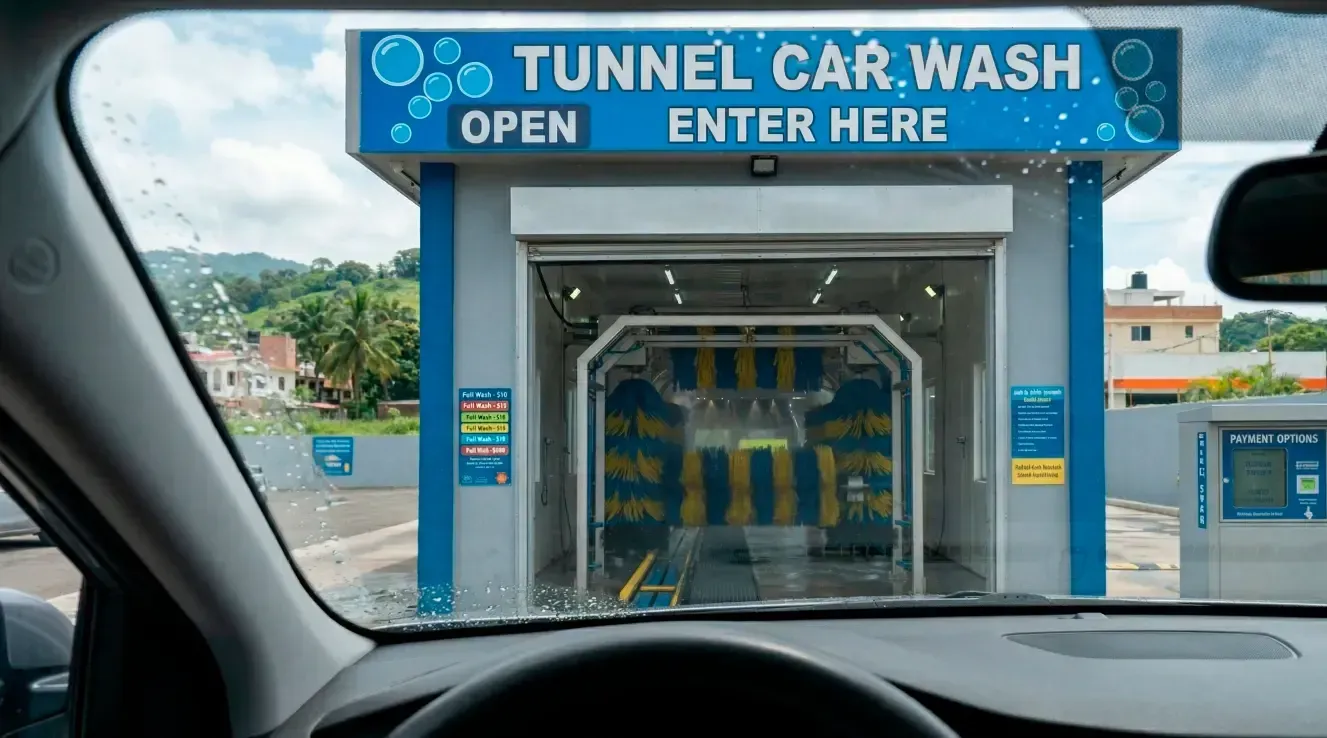
Tunnel-style car washes are operational systems. That means there are edge cases: loose items, mirrors, antennas, racks, unexpected contact, or minor damage claims.
Your goal isn’t to assume damage will happen. It’s to know what the process is if it does.
Damage/claims process: what “notify immediately” means in practice
Many claims processes depend on immediate reporting. If that’s the standard, your drivers need to know it.
Ask the vendor:
- What is the claims process step-by-step?
- What is the required timeframe for reporting?
- Who should the driver speak to on-site?
- What documentation helps (photos before/after, incident notes)?
Then align your internal process:
- A short driver instruction: “If you notice an issue, stop and notify staff before leaving.”
- A simple internal note: date/time, vehicle, location, summary, photos.
Loose items + vehicle prep responsibilities (what your driver policy should say)
Loose items are a common issue, and they’re also one of the easiest things to control.
Ask:
- What items must be removed or secured?
- Are there restrictions on exterior attachments?
- Are there vehicle types that require special handling?
Then translate it into your driver policy in one paragraph:
- remove/secure loose exterior items
- follow lane guidance
- don’t override system rules
- report issues immediately
This reduces risk without turning you into a compliance officer.
Proof posture: what you should document before rollout
Before you roll out a fleet wash program to all vehicles, document what you need to confidently manage it.
At minimum:
- A vehicle list (plates, vehicle types, special attachments)
- Your internal policy rules (who can wash, how often, what package level)
- The vendor’s written confirmation of eligibility and billing terms (TBD if not provided)
- A sample invoice and sample usage report (if available)
This isn’t paperwork for paperwork’s sake. It’s what prevents confusion later when something goes wrong and everyone asks, “What did we agree to?”
The contrarian moment: “Unlimited” isn’t a fleet program
Here’s the misconception that causes the most fleet program pain:
If a consumer membership program says “unlimited washes,” it must work for fleet.
Not necessarily.
Consumer programs are designed for one person and one vehicle. Fleet programs are designed for multiple vehicles, multiple drivers, and accountability. That’s a different problem.
Where consumer-style programs often break for fleet needs:
- Eligibility exclusions show up after you try to enroll certain vehicles
- Billing becomes messy when each vehicle has separate renewal logic
- Reporting is too thin for auditability
- Controls are limited, so misuse becomes hard to prevent
- Exception handling puts drivers on the spot
What a fleet-ready program must include:
- Clear vehicle eligibility rules (in writing)
- Fleet-ready billing (consolidated, predictable, reconcilable)
- Vehicle-level reporting you can export
- A practical exception process when recognition fails
- Clear controls to match your driver policy
You can absolutely use subscription economics in a fleet setting. But the structure has to match the fleet reality.
Next steps: a low-friction way to evaluate a local provider in 30 minutes
If you’re short on time, don’t try to solve everything at once. Evaluate the program like a small operational pilot.
The one-page decision sheet: vehicles list + vehicle types + desired reporting
Before you call or visit, prepare one page:
- Total vehicle count (5–20)
- Vehicle types (sedans, vans, pickups, branded vehicles, vehicles with racks/attachments)
- How often you expect washes (rough estimate, not a promise)
- Your billing preference (one invoice vs per vehicle)
- Your minimum reporting needs (vehicle-level usage, timestamps, export)
This makes the conversation concrete and prevents vague answers.
Pilot suggestion: pick 2–3 vehicles, test exception handling and reporting
A pilot is the fastest way to discover if the program works in real life.
Choose 2–3 vehicles that represent your reality:
- one standard vehicle
- one vehicle with any special considerations (branding, attachments, route dirt, etc.)
- one vehicle assigned to a driver who will actually use the process
During the pilot, test:
- does access work reliably?
- how are exceptions handled?
- does billing align with what was promised?
- can you pull a usable usage report?
If the pilot results are clean, scaling is straightforward. If they aren’t, you just saved yourself a fleet-wide headache.
CTA path: request fleet/corporate options and confirm terms in writing
Managing 5–20 vehicles? Ask about fleet/corporate wash options—not just consumer memberships.
Share your vehicle count and types, and request (1) eligibility confirmation, (2) a sample invoice, and (3) a sample usage report.
If it all checks out, start with a small pilot group and scale from there.
FAQ
What questions should I ask before signing a fleet car wash program?
Ask about eligibility by vehicle type, how access works (and what happens when it fails), billing timing and consolidation, reporting capability, controls to prevent misuse, add-on handling, and the claims process. If the vendor can’t answer clearly or in writing, treat that as a risk to resolve before rollout.
Are “unlimited wash memberships” valid for fleet or commercial vehicles?
Sometimes—but not always. Many “unlimited” programs are built for consumer use and may have restrictions that don’t fit fleet vehicles or certain vehicle uses. The safest approach is to ask whether a dedicated fleet/corporate program exists and to confirm eligibility for your vehicle types in writing.
How do corporate car wash rates usually work (per vehicle vs pooled)?
Corporate programs are often structured per vehicle, but the billing and reporting approach varies. Some providers can consolidate billing into one invoice while still tracking usage per vehicle. Ask whether the program is per vehicle, pooled, or hybrid—and what reporting is included.
What reporting should a fleet wash program provide for 5–20 vehicles?
At minimum, you want vehicle-level usage with timestamps and package detail, plus a way to export the data (often CSV). You should also confirm who can access reporting and whether reports can be generated on-demand. If reporting is limited, plan for higher admin time and less auditability.
Is a fleet wash membership better than vouchers or prepaid packages?
It depends on your priorities. Membership can be simpler if billing and reporting are fleet-ready, but vouchers or prepaid options can offer tighter control if reporting is weak or eligibility is complicated. Evaluate based on how well each option supports your audit trail, driver policy, and operational predictability.
How do I manage multiple vehicles at a car wash without driver misuse?
Make the process vehicle-based where possible (so access is tied to the vehicle, not the driver), require vehicle-level reporting, and set clear internal rules about who can wash and what package is allowed. Also confirm with the vendor how exceptions and add-ons are handled so drivers aren’t pushed into workarounds.
Request a fleet/corporate program quote + confirm eligibility and reporting
Managing 5–20 vehicles? Ask about fleet/corporate wash options—not just consumer memberships.
Share your vehicle count and types, and request (1) eligibility confirmation, (2) a sample invoice, and (3) a sample usage report.
If it all checks out, start with a small pilot group and scale from there.